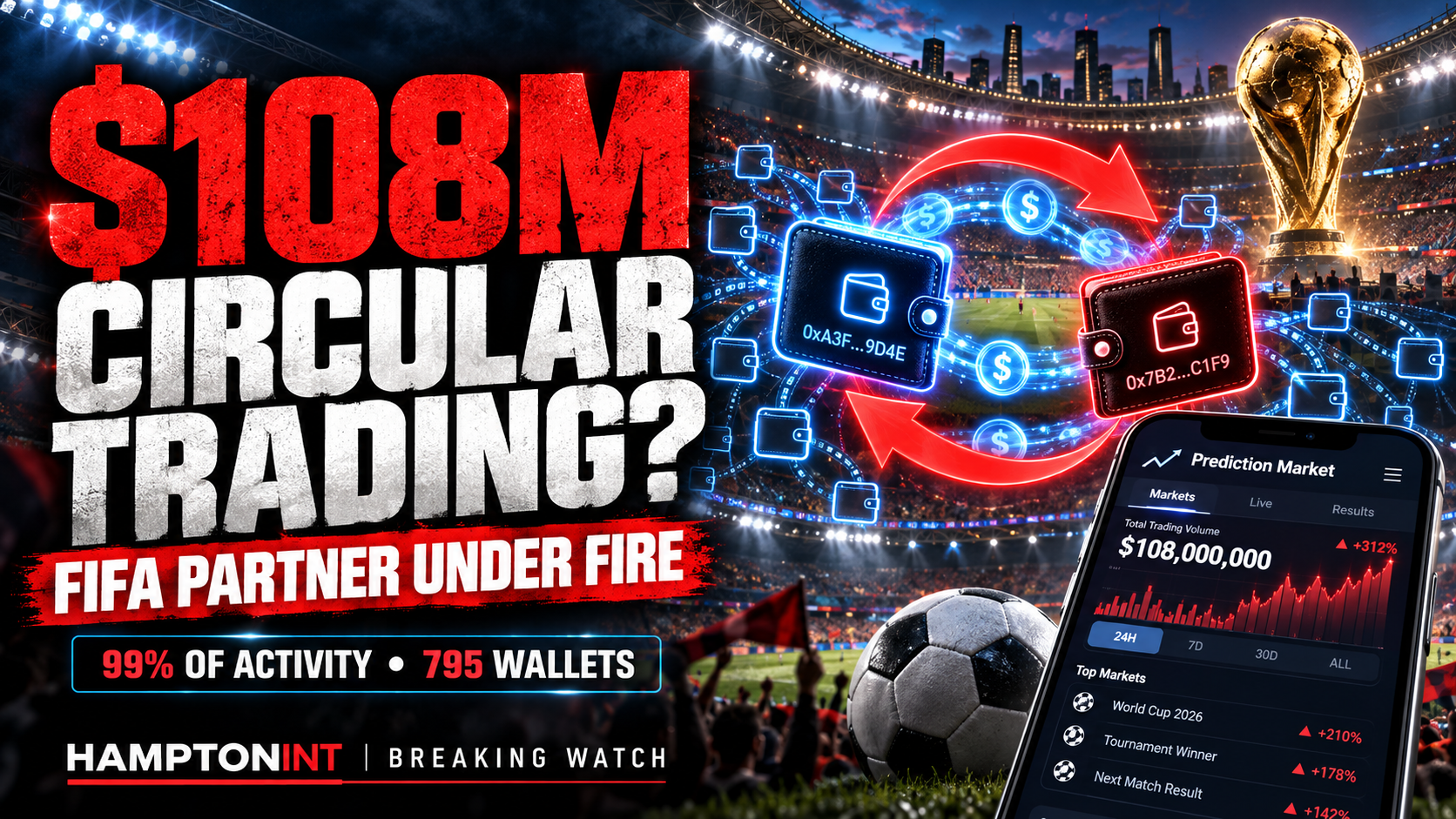
A Wall Street Journal investigation found that approximately $108 million of ADI Predictstreet's $167 million in trading through late September came from cryptocurrency wallets apparently linked through a common funding source.
Since late August, a network of just 795 wallets reportedly generated 99% of the platform's activity. The accounts traded mostly among themselves and were funded by a wallet that also collected the platform's trading fees.
Independent experts and Solidus Labs reviewed the blockchain analysis and characterized the activity as inorganic. ADI Predictstreet didn't respond to the Journal. FIFA declined to comment.
ADI Predictstreet was FIFA's official prediction-market partner for the 2026 World Cup — promoted as a transparent platform representing collective fan intelligence.
Why It Matters
Prediction markets sell trading volume as evidence of adoption and crowd conviction. If most activity comes from interconnected wallets circulating funds, the headline numbers may reveal very little about genuine demand or public belief.
After similar questions surrounding Polymarket's $600M zombie-trade controversy, circular trading now looks less like an isolated platform problem and more like an industry-wide credibility threat.
The FIFA connection makes this story different. Polymarket was a crypto-native platform. ADI Predictstreet was the official partner of the world's most-watched sporting event — marketed to hundreds of millions of fans as a window into collective intelligence. If the crowd was mostly 795 wallets, that's not a data anomaly. That's a fraud question.
Breaking It Down: 795 Wallets, $108 Million, One Fee Collector
The blockchain trail described in the WSJ investigation has a specific structure that makes it particularly damning: the same wallet that collected trading fees also funded the wallets doing the trading.
That's not a coincidence. In a legitimate market, fee collectors and market participants are separate. When they're connected, you have a system where the platform profits from volume it may have manufactured itself.
Solidus Labs — one of the leading blockchain surveillance firms — reviewed the analysis and called the activity inorganic. That's the technical term for trading that doesn't reflect genuine market participation.
99% of activity from 795 wallets. In a platform promoted as capturing the wisdom of World Cup fans worldwide. The math doesn't work — and the blockchain doesn't lie.
The FIFA Angle: Selling 'Collective Intelligence' to the World
FIFA didn't just allow ADI Predictstreet to operate alongside the World Cup. It made the platform an official partner — lending it the credibility of the world's most recognized sports brand.
The marketing language was specific: collective fan intelligence, crowd wisdom, transparent prediction markets. Fans were told the platform's odds reflected what millions of people actually believed about match outcomes.
If 99% of that activity came from 795 interconnected wallets, the 'collective intelligence' was a fiction. And FIFA's silence — declining to comment to the Journal — raises its own questions about what the organization knew and when.
This isn't just a crypto story. It's a sports integrity story. And it lands at the feet of the organization that runs the most-watched tournament on earth.
The HamptonINT Perspective
We've been tracking the prediction market integrity story since New York sued Polymarket, through Connecticut's crackdown on nine platforms, through the $600M zombie-trade investigation. ADI Predictstreet is the next chapter — and it's the most damaging yet.
Every previous case involved platforms operating in regulatory gray zones. This one had FIFA's official endorsement. That changes the stakes entirely.
The pattern is now clear: prediction market platforms have been scaling volume faster than their integrity infrastructure — and in some cases, the volume itself may have been manufactured. The industry needs independent, third-party blockchain surveillance as a condition of operation. Not as a suggestion. As a requirement.
When wallets trade with each other, volume becomes marketing — not information. And when that marketing carries FIFA's logo, the deception reaches a global audience.
What to Watch Next
- Whether FIFA issues a formal response or terminates its relationship with ADI Predictstreet.
- Whether U.S. or international regulators open investigations based on the WSJ's blockchain analysis.
- Whether Solidus Labs or other blockchain surveillance firms publish their full findings.
- Whether other FIFA commercial partners face similar scrutiny as the World Cup's financial ecosystem comes under review.
HAMPTONINT — Where the Streets Meet the Stats.
Entertainment First. Education Always. Reality Over Illusion.
Educational commentary only — not gambling or financial advice.
Stay Updated
Subscribe to our newsletter and get the latest updates, news, and offers straight to your inbox.