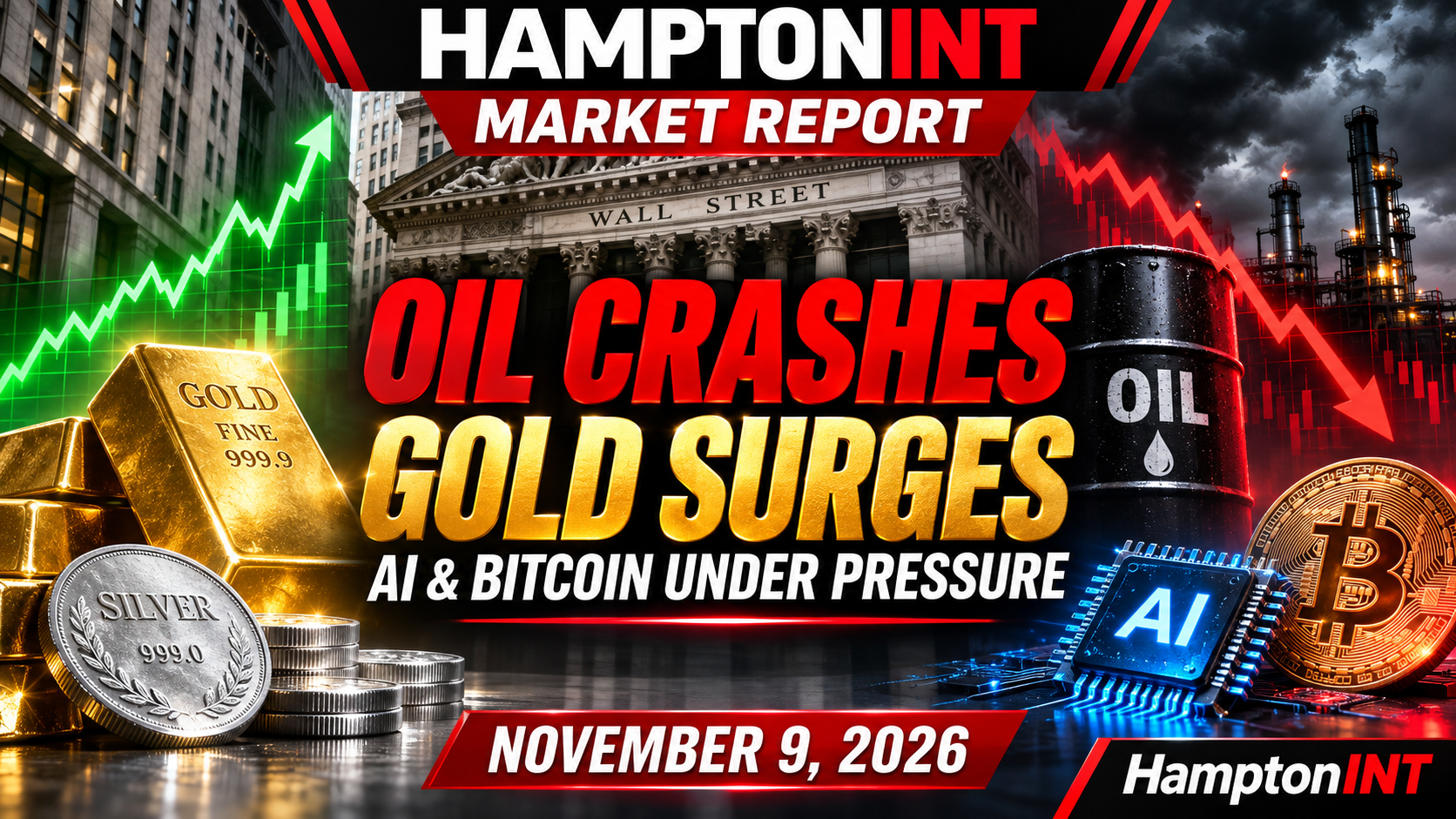
Monday Market Report: Oil Crashes, Gold Surges, AI & Bitcoin Under Pressure
The market is sending two messages. Oil's war premium is collapsing, which may reduce inflation pressure. But technology, crypto and energy equities are still absorbing heavy losses as investors question AI spending, regulation and risk.
U.S. ETF readings reflect the November 6 close because regular trading has not opened. Gold, silver, oil and Bitcoin trade internationally.
Verified Market Dashboard
| Market | Latest Level | Weekly Move | Trend |
|---|---|---|---|
| Gold | $4,113/oz early Monday | GLD +4.7% | Recovering |
| Silver | $52.57/oz early Monday | SLV +5.1% | Rebounding, volatile |
| Uranium | $91.85/lb | Approx. +1.3% | Firm |
| Uranium equities | URA $32.34 | -4.1% | Weak |
| Brent crude | Approx. $98/barrel | About -16% | Sharp correction |
| WTI crude | Approx. $91/barrel | About -13% | Correcting |
| Energy equities | XLE $61.62 | -12.0% | Bearish short term |
| Bitcoin | Approx. $74,000 | Roughly -5% | Under pressure |
| S&P 500 proxy | SPY $735.29 | -2.7% | Correcting |
| Nasdaq-100 | QQQ $656.10 | -5.0% | Risk-off |
Gold
Verified Facts
Spot gold traded near $4,113 per ounce early Monday, extending a weekly gain of approximately 5%. Silver reached roughly $52.57 per ounce. Lower oil prices and a softer dollar reduced some inflation and interest-rate pressure. However, October's strong employment report increased market expectations for a December Federal Reserve rate increase.
HamptonINT Analysis
Gold is regaining its role as portfolio protection while technology, energy and crypto weaken. But the setup is not clean: stronger employment and hot inflation could push yields and the dollar higher.
- Main catalyst: Falling oil, weaker dollar and defensive demand.
- Key risk: Hot CPI data and rising real interest rates.
- Watch next: Whether gold holds $4,000 and challenges the $4,130–$4,150 range.
Silver
Verified Facts
Silver rose to approximately $52.57 early Monday after SLV gained about 5.1% last week. Silver benefited from gold's recovery, but its industrial side remains exposed to economic-growth concerns and weakness in technology-related demand.
HamptonINT Analysis
Silver is acting like a higher-volatility version of gold. The rebound is meaningful, but silver must prove it can hold above $50 without depending entirely on gold.
- Main catalyst: Precious-metal demand and easing rate pressure.
- Key risk: Manufacturing weakness and another dollar rally.
- Watch next: Support near $50 and resistance around $53–$55.
Uranium and Nuclear Energy
Verified Facts
Physical uranium ended Friday near $91.85 per pound, up approximately 1.3% for the week and 18.6% year over year. URA closed at $32.34, gaining 4.4% Friday but losing approximately 4.1% for the week — a clear separation between physical uranium and uranium-related equities.
HamptonINT Analysis
The physical market remains supported by supply constraints, utility contracting and long-term nuclear demand. Uranium stocks are still behaving like speculative risk assets.
- Main catalyst: Nuclear expansion, electricity demand and long-term utility contracts.
- Key risk: Financing costs, project delays and continued selling in high-beta equities.
- Watch next: Whether uranium holds $90 and whether URA can reclaim $34–$35.
Oil and the Broader Energy Sector
Verified Facts
Brent crude traded near $98 per barrel, while WTI held around $91 early Monday. Brent lost approximately 16% last week — its steepest weekly decline since the beginning of the COVID era. XLE fell 12%. The correction followed President Trump's statement that new attacks on Iran were highly unlikely while diplomatic discussions continued. Shipping risks around the Strait of Hormuz have not disappeared.
HamptonINT Analysis
The energy trade just demonstrated how quickly geopolitical premiums can evaporate. Oil is still expensive compared with normal historical ranges, but momentum has reversed. Lower oil could help consumers, transportation companies and the inflation outlook. It also damages the recent profit expectations built into energy stocks.
- Main catalyst: Diplomatic progress and reduced fears of supply disruption.
- Key risk: Failed negotiations, renewed attacks or interrupted shipping.
- Watch next: Brent's ability to hold $95–$98, Strait of Hormuz activity and Occidental Petroleum's earnings.
Bitcoin
Verified Facts
Bitcoin fell toward $74,000 early Monday, reaching its lowest level since August. The decline followed concerns that the new Democratic-controlled Congress may pursue stricter crypto regulation. Confidence was already weakened by the recent multibillion-dollar Binance security breach.
HamptonINT Analysis
Bitcoin is dealing with three risks at once: regulatory uncertainty, exchange and custody concerns, and higher interest-rate expectations. The Bitcoin network and the platforms surrounding it are different risks. The Binance situation is another reminder to study the wrapper — not only the asset.
- Main catalyst: Institutional demand and any constructive regulatory framework.
- Key risk: Tougher legislation, exchange withdrawals and leveraged liquidations.
- Watch next: Support around $73,000–$74,000. Bitcoin must reclaim $77,000, then $80,000, to repair momentum.
S&P 500
Verified Facts
SPY closed Friday at $735.29, losing approximately 2.7% for the week. The S&P 500 rose 0.31% Friday, but the rebound did not erase the week's damage. October payrolls increased by 165,000, while unemployment held at 4.1%, confirming that the labor market remains resilient.
HamptonINT Analysis
The S&P 500 is bending, but it has not broken. Lower oil provides relief, while strong employment supports consumer demand. The problem is that the same employment strength gives the Fed more room to raise rates.
- Main catalyst: Earnings growth and falling energy costs.
- Key risk: Hot inflation, higher rates and declining market breadth.
- Watch next: Whether SPY can defend $730 and recover $750–$760.
QQQ and the AI Trade
Verified Facts
QQQ closed at $656.10, falling approximately 5% for the week. The Nasdaq dropped 5.5% Thursday — its worst session since April 2025 — as investors reacted to AI spending concerns and the possibility of tighter regulation following the midterm elections. Roughly $2.5 trillion in Nasdaq value was erased during that session.
HamptonINT Analysis
AI demand is not dead. The market is challenging the price paid for that growth. Companies now need to show revenue produced by AI, improving margins, controlled capital spending, sustainable cash flow, and a realistic return on data-center investment. Wall Street wants proof — not another AI presentation.
- Main catalyst: Profitable AI growth and strong earnings guidance.
- Key risk: Regulation, rising rates and spending without adequate returns.
- Watch next: QQQ support around $650 and earnings from CoreWeave, Cisco and Applied Materials.
Federal Reserve and Economic Developments
The Federal Reserve held its target rate at 3.75%–4.00% on October 28. Two policymakers preferred another quarter-point increase, showing that inflation concerns remain active. Markets currently assign approximately a 79% probability to a December rate increase.
- Tuesday, November 10: October CPI and real earnings at 8:30 a.m. ET
- Wednesday, November 11: Veterans Day — bond market closed, stock market open
- Thursday, November 12: Weekly jobless claims and existing-home sales
- Friday, November 13: October PPI at 8:30 a.m. ET
Earnings and Market Catalysts
- Monday: Constellation Energy, Barrick Mining, Occidental Petroleum, Take-Two and Rocket Lab
- Tuesday: CoreWeave and other AI- and computing-related companies
- Thursday: Cisco and Applied Materials
CoreWeave's report will test the economics of AI infrastructure. Occidental will provide a direct reading on the oil correction's impact on producer margins.
Educational research only — not investment, financial, tax or legal advice.
Stay Updated
Subscribe to our newsletter and get the latest updates, news, and offers straight to your inbox.